


Improve Your Relationships
Learn how to make relationships work! Whether it's your Mom, your Sibling, your Teacher or your spouse. Improving relationships is the best way to increase your satisfaction with life and your everyday happiness. Better relationships almost never come from one big dramatic fix. They come from small, learnable skills: how to listen so someone feels heard, how to raise the hard thing without a fight, how to rebuild trust one honest moment at a time. This page gathers the resources that actually teach those skills. Below you will find our honestly ranked picks for every stage, dating, marriage, family, friendship, and repair, each one scored on merit, with its strengths and its limits laid out plainly. No pickup tricks, no games, nothing that treats people as things to win. Just credible, caring help you can put to use this week. Pick the situation that fits your life right now, start with one resource, and try one small change. Connection responds to attention faster than almost anything else. Scroll down, and give yours a little.


What are you working on?
Welcome to our choices for the best resources on building a lasting love and meaningful relationships. Scroll through these incredible tools, free resources, and powerful products to make your relationships grow and thrive.
Not sure?
Just scroll & enjoy!
A note on how we keep the lights on.

Unsure of your first move to a more healthy future?
Start Here.
Start your journey with these incredibly helpful Free resources. We love these apps and guides because they make amazing relationships an achievable goal. Explore these and make your new life attainable, manageable, practical, and within reach. Go for it!
A note of caution: As always with free apps and tools, be careful about hidden subscriptions. We love these resources, but we are not partners or affiliates, so enjoy the free versions and upgrade only when you're ready.
Free Apps & Tools

Start with this illuminating journey into you.
Set yourself up for success in all your relationships with this remarkable introspective guide that helps you to realize how much you have to offer.
This Popcycle Journal is a guided reflection designed for adults ready to understand their own patterns in love, friendship, and family; before the next relationship begins, or to deepen the one they are in. Drawing from attachment theory, Gottman research, and the work of writers like Esther Perel, Terry Real, and Lindsay Gibson, each day presents one carefully-sequenced question with a reflection prompt and a 'One Small Shift' commitment. Week one is archaeological: the patterns you carry. Week two is inventory: your real strengths and non-negotiables. Week three is harder: ungrieved loss, your own complicity, forgiveness. Week four is becoming: self-respect in daily practice, qualities beyond chemistry, the life worth building with or without a partner.
Your writing auto-saves to your browser, and when you finish, you can download your complete journal as a text file to keep. Honest. Uncomfortable in the right places. Deeply practical ... and Free. No e-mail, no credit card, no paywall.
Our gift to your journey, take a few minutes for a few days and truly Sweeten Your Life!
Gottman Card Decks
40+ decks of Gottman research prompts — free on your phone.
The Gottman Card Decks app gives you access to over 40 decks of research-based conversation prompts covering everything from love maps and bids for connection to intimacy and conflict recovery. These are the actual exercises Gottman therapists use in sessions, available for free on your phone. Use them on a date night, during a walk, or whenever you want to have a real conversation instead of talking about logistics.
Why we Love this . . .
It is free, it is research-backed, and it gets couples talking about things that actually matter. This is the easiest possible starting point for any relationship.

The Gottman Institute
Love Languages Quiz
Understand how you and your partner give and receive love — free in 10 minutes.
Gary Chapman's Five Love Languages framework has become one of the most widely used relationship tools for a reason: it gives couples a shared vocabulary for a real problem. Most relationship friction isn't about not caring — it's about expressing care in a language the other person doesn't feel. The official quiz takes about 10 minutes and immediately shows you your primary and secondary love languages. Best used as a starting conversation, not a final answer.
Why we Love this . . .
The framework isn't magic, but the conversation it starts usually is. Most couples are surprised by each other's results. That surprise is the point.

Gary Chapman
Relish: 7-Day Free Trial
Try daily relationship coaching free for a week — no credit card stress.
Relish offers a full 7-day free trial of its daily coaching platform — enough time to experience how it actually changes the texture of your conversations with a partner or your thinking about yourself in relationships. The trial includes access to personalized coaching sessions, quizzes, and the daily prompt feature. For $9.99/month after, it is also the most affordable paid option in this category.
Why we Love this . . .
Seven real days with real prompts. You will know by day three whether it is working for you.

Relish
Attachment Style Quiz
Find out your attachment style — and why it keeps showing up in your relationships.
Understanding your attachment style is one of the highest-leverage things you can do for your relationships. It explains why you respond the way you do under stress, why certain relationship dynamics keep repeating, and what kind of support you actually need versus what you ask for. The Attachment Project's free quiz is one of the most accurate available, based on current academic research rather than pop psychology.
Why we Love this . . .
This is the kind of self-knowledge that changes the way you see every relationship you have ever had. Take it, then share it with your partner.

The Attachment Project
Between: Private Space for Two
A private space just for two — messaging, memories, and moments that are yours alone.
Between is a private app designed just for two people — a shared space for messaging, memories, an anniversary countdown, a joint calendar, and a photo album that belongs only to the two of you. It is not a therapy tool or a communication trainer. It is simply a dedicated, private place for your relationship that lives separately from the noise of social media and group chats. The free version covers the core features and is genuinely useful.
Why we Love this . . .
There is something meaningful about having a space for your relationship that is not shared with anyone else. Between is simple, pretty, and does exactly what it says.

VCNC
Paired: Daily Questions for Couples
One question a day. Answered separately. Revealed together. You'll be surprised.
Paired sends both partners one question a day — then reveals each other's answers simultaneously so neither person is influenced by the other's response first. The questions range from lighthearted to surprisingly deep, and the reveal mechanic creates a small shared moment of discovery every day. Couples who have been together for decades consistently report learning things they did not know about each other. The free version gives you access to daily questions indefinitely.
Why we Love this . . .
The simultaneous reveal is clever — it removes the social pressure to match your partner's answer and makes the whole thing more honest. Deceptively simple and genuinely connecting.

Paired

Unsure how to start? These are our picks for direction and motivation for your body's next life.
Podcasts
we love.
Somewhere out there, someone has already figured out the thing you're wrestling with; and they talked about it for an hour, for free. These podcasts turn dead time into growth time. Real insight from people who've done the work, free and ready whenever you are. These are the shows we keep coming back to, the ones that turn a commute, a walk, or a load of dishes into a little masterclass in becoming who you're meant to be.
The Fine Print: We are not doctors. We don't even play them on TV, but we do like these Podcasts and we've gotten a lot out of their informative shows. We hope you do too, but keep in mind: you have to make your own decisions on your health and your mental well being. Relationship advice is everywhere, get more than one opinion, and always check with your doctor. Enjoy!
Where Should We Begin?
Esther Perel
Real couples therapy sessions with Esther Perel. Raw, private, and impossible to stop listening to.
Esther Perel is one of the most respected voices in relationships alive right now, and this podcast is unlike anything else available. You are listening to actual couples therapy sessions — real people, real problems, real moments of breakthrough and resistance. Perel's approach is brilliant: she finds the story underneath the story, the thing neither partner has said yet, and surfaces it gently but precisely. Even when the situation on tape has nothing to do with your own life, you will hear something that does.
Why we Love this podcast ...
Listening to other couples work through their real problems is one of the most empathy-expanding things you can do. Perel makes you understand people you thought you couldn't.

Listen on ...

SPOTIFY

Apple Podcasts
Small Things Often
The Gottman Institute
The Gottman research in bite-size form. Five minutes a day, built around the idea that small things done often matter more than grand gestures.
Based on more than four decades of research by Drs. John and Julie Gottman, this short-form podcast distills Gottman principles into five-minute, immediately usable tips. Episodes cover bids for connection, repair attempts, managing conflict, nurturing fondness and admiration, and the daily micro-skills that distinguish couples whose relationships thrive from those whose don't. It is the easiest possible on-ramp into Gottman's work, and the format makes it stick. The podcast's premise comes directly from one of the Gottmans' core findings: it is the small, repeated acts of attention that build or erode a relationship over time, not the big moments.
Why we Love this podcast ...
Five minutes is short enough that you will actually listen daily. And because every episode gives you one specific, research-backed thing to try, the ratio of effort to behavior change is unusually high.

Listen on ...
SPOTIFY
Apple Podcasts
The Love, Happiness and Success Podcast
Dr. Lisa Marie Bobby
A decade of practical wisdom on love, growth, and the relationship between them.
Dr. Lisa Marie Bobby is a therapist, marriage counselor, and life coach who has been producing this podcast for over a decade. Her approach is integrative — she pulls from psychology, neuroscience, attachment theory, and practical coaching to help people build better relationships and better lives. Episodes cover both relationship dynamics and personal development, which reflects the reality that the two are inseparable. Clear, compassionate, and consistently useful.
Why we Love this podcast ...
She talks to you like a smart, warm friend who also happens to have a PhD. That combination is rare and valuable.

Listen on ...
SPOTIFY
Apple Podcasts
Relationship Alive Podcast
Neil Sattin
The world's best relationship researchers, interviewed at length. Start with the Gottman episode.
Neil Sattin interviews the leading minds in relationship science — John Gottman, Sue Johnson, Terry Real, Stan Tatkin, and dozens more — in long-form conversations that go deeper than the usual podcast format. If you want to understand the underlying models and research that inform modern relationship therapy, this is the most comprehensive free resource available. Episodes run 60-90 minutes and reward the full listen.
Why we Love this podcast ...
The Gottman and Sue Johnson episodes alone are worth subscribing for. This is graduate-level relationship education presented accessibly.

Listen on ...
SPOTIFY
Apple Podcasts
The Jefferson Fisher Podcast
Jefferson Fisher
The communication tools you wish you had the last time a conversation went sideways. Short episodes, no fluff.
Jefferson Fisher went viral on Instagram for teaching people how to communicate under pressure, and this podcast is the long-form version of that work. He draws from fifteen years as a Texas trial lawyer, where arguing well is a daily skill, and translates it into things anyone can use at a dinner table or in a difficult text thread. Episodes cover how to disagree without damaging the relationship, how to stop reacting defensively, how to ask a better question, how to end a conversation that has gone off the rails. For anyone who has ever walked away from a conversation thinking I should have said this, this show is the retraining.
Why we Love this podcast ...
Communication is the single most useful relationship skill, and most of us were never actually taught it. Fisher teaches it clearly and gives you something to try before the episode is over.

Listen on ...
SPOTIFY
Apple Podcasts
Modern Love
The New York Times
The best writing about love published anywhere, read aloud and discussed. The one you listen to and then sit in the car for another minute.
Modern Love began as a weekly column in The New York Times in 2004 and became one of the most read sections of the paper for one reason: it tells the truth about love. The podcast brings those essays to life. Each episode opens with an actor or musician reading a Modern Love essay (past readers include Dakota Fanning, Ethan Hawke, Catherine Keener, John Slattery, Lupita Nyong'o), then host Anna Martin talks with the essay's author about what happened after the piece was published. The result is a show that stretches your understanding of what love is and who it is for across every stage of adult life. Dating, long marriages, grief, divorce, friendship, caregiving, estrangement, reconciliation. If Esther Perel is the therapist's view and Gottman is the researcher's view, Modern Love is the writer's view: specific, honest, and unforgettable.
Why we Love this podcast ...
The writing is extraordinary, and hearing actors read it adds a layer that a page cannot. It is also one of the few places where love after 40 is treated as a central subject rather than an afterthought.

Listen on ...
SPOTIFY
Apple Podcasts

I've read the diet section of every bookstore I've ever walked into. These are the ones I kept.
Books
we love.
Most books in this category say the same things. New plan, new villain: food, and the same promise. After a while you can spot the pattern from the introduction alone.
These six didn't. Each taught me something I didn't already believe, or said something true that nobody else was willing to say. One of them changed how I think about habits entirely, not just food habits, all habits. Another made me genuinely angry about how long the wrong information has been treated as common sense.

Explore it on ...


The Seven Principles for Making Marriage Work
John Gottman & Nan Silver
This is the book. If you read one book on relationships in your life, Gottman's Seven Principles is it. It identifies the specific behaviors and patterns that predict whether a couple will thrive or struggle, and translates four decades of laboratory research into practical exercises. The four horsemen of the apocalypse — criticism, contempt, defensiveness, stonewalling — and how to counteract each of them. The concept of love maps and why couples who know each other's inner worlds are more resilient. The role of repair attempts and why they work even when imperfect. Nothing in popular relationship advice comes close to the evidentiary basis of Gottman's work.
Why we Love this book ...
Every piece of advice in here has data behind it. Gottman didn't guess — he watched thousands of couples and followed them for years. That changes how much you trust what he says.

Explore it on ...
Mating in Captivity
Esther Perel
Perel's central argument is simultaneously obvious and revelatory: the things that create security in a relationship — familiarity, routine, predictability — are the very things that erode desire. Mating in Captivity explores this tension not to resolve it with a neat solution, but to help couples understand it well enough to navigate it consciously. It is challenging, beautifully written, and will change how you think about long-term intimacy. This is not a book with a tidy checklist. It is a book that rewires something.
Why we Love this book ...
Perel writes like she thinks — in paradoxes and revelations. You will dog-ear this one.

Explore it on ...
Hold Me Tight
Dr. Sue Johnson
Sue Johnson is the creator of Emotionally Focused Therapy, which has among the strongest research outcomes of any couples therapy modality. Hold Me Tight is her accessible explanation of EFT written for couples rather than clinicians. The central insight is deceptively simple: most relationship conflict is not really about the content of the argument. It is about a deeper emotional question — are you there for me? Am I safe with you? Johnson shows you how to hear those questions underneath the surface conflict and how to answer them in a way that actually lands.
Why we Love this book ...
The chapter on demon dialogues — the circular arguments couples have that never resolve — is worth the entire book by itself.

Explore it on ...
Attached
Amir Levine & Rachel Heller
Levine and Heller translated academic attachment research into one of the most practically useful relationship books available. The three adult attachment styles — secure, anxious, and avoidant — and how they interact with each other explains more about relationship dynamics than almost any other single framework. Anxious-avoidant pairings in particular produce a specific predictable dance that the book describes so accurately that most readers feel seen in an unsettling way. Understanding your own style and your partner's changes how you interpret behavior that used to feel personal.
Why we Love this book ...
The anxious-avoidant dynamic section reads like someone watched your relationship from across the room. Accurate in a way that is sometimes uncomfortable and always useful.

Explore it on ...
The State of Affairs
Esther Perel
Perel approaches infidelity the way a good therapist should — without judgment and with genuine curiosity about what affairs mean and why they happen. This is not a book that excuses betrayal or prescribes forgiveness. It is a book that takes the full complexity of the situation seriously: what the affair means to the person who had it, what it does to the person who discovers it, and what the path through looks like for couples who choose to try. Even for couples who have not experienced infidelity, it illuminates truths about desire, loneliness, and unmet needs that are quietly present in many relationships.
Why we Love this book ...
Perel is the only writer who can make you feel compassion for everyone in a situation where compassion seems impossible. That is a rare skill.

Explore it on ...
Us
Terry Real
Terry Real is a therapist who does not believe in being gentle when the relationship is at stake. Us is about the shift from 'you vs. me' to 'us' — how ego, entitlement, and adaptive childhood patterns keep couples stuck in conflict that doesn't resolve. Real is especially sharp on how men are socialized in ways that make genuine intimacy harder, and how women often adapt to that in ways that aren't serving them either. The book is direct, occasionally uncomfortable, and deeply practical. Particularly resonant for the 35-65 demographic who have real relationship history and real patterns to examine.
Why we Love this book ...
Real tells the truth in a way that most therapists won't. It is bracing and useful in equal measure.

Explore it on ...
Adult Children of Emotionally Immature Parents
Lindsay C. Gibson, PsyD
Dr. Lindsay Gibson is a clinical psychologist who has worked with adult children of emotionally immature parents for over 30 years, and this book is the compassionate, clinically grounded result. The book names four types of emotionally immature parents (emotional, driven, passive, and rejecting), explains how children adapt to each, and lays out a path for adult children to recognize those adaptations, grieve what was missing, and build a self that is no longer organized around managing a parent. It has become one of the most quietly influential books on adult development of the last decade because it names things most readers have felt their whole lives but never had language for. For anyone whose parent remains a difficult relationship in adulthood, or who is noticing those same patterns in themselves, this is essential reading.
Why we Love this book ...
Most books about difficult parents either pathologize them or push forgiveness too fast. Gibson does neither. She names the patterns precisely, respects the complexity of the relationship, and gives adult readers tools to grow past the dynamic without needing the parent to change first. That matters, because the parent usually will not.
Unsure how to start? These are our picks for direction and motivation for your body's next life.
The Best Loving & Learning Tools, Apps & Programs
We've reviewed dozens so you don't have to.
Every product on this page earned its place. We scored each one on effectiveness, real-world reviews, value, and whether we'd actually hand it to someone we care about. No paid placements. No shortcuts. Just the honest list.
The Fine Print: We are not doctors. We don't even play them on TV, but we do like these products and we've gotten a lot out of their potential value. We hope you do too, but keep in mind: you have to make your own decisions on your health. Get more than one opinion, and always check with your doctor. Enjoy!
22+ 5 100
Product Reviews Sub-Categories Popcycle Score

POPTOPS
🎯
Our
Top Picks
If you only have five minutes, these are the decisions we would make for you.
at a glance
Reviews
Every Product
reviewed
honestly
🎯
Here is exactly why each one made the cut, and who it is actually right for.
🎯
Effectiveness First
FirstDoes it actually work? We weighted real-world results and verified user reviews above everything else.
💰
Honest About Cost
We tell you what things actually cost, including subscriptions, upsells, and the fine print.
Some links are affiliate links. Our scores are not. No product bought its way onto this page.
🤝
No Hidden Agenda

Dating

Match.com
Find Someone Worth Showing Up For
Match has been connecting serious relationship-seekers since 1995, and the demographic of active users reflects that history. The profile depth and matching intelligence are meaningfully better than swipe-based apps because the platform attracts people willing to invest time in the process. For anyone in the 35-65 demographic who wants a real relationship rather than a casual connection, Match is consistently where those relationships actually start. The paid subscription signals intent on both sides.
$20-45/month
Price:
Best For:
Adults 35+ seeking commitment
Why we love this . . .
The self-selection matters. When you pay for a dating platform, the people around you have also paid — which filters out a significant portion of people who are not serious. Match has 30 years of doing this, and the user base in the 35-65 range is proportionally larger than on any swipe-based competitor. If you want to meet someone who is actually looking for a relationship, you are more likely to find them here.
87
POPCYCLE SCORE

eHarmony
The App Designed for Serious Relationships
eHarmony's 32-dimension compatibility matching is the most thorough personality-based approach in consumer dating. The extensive questionnaire upfront screens out casual users by design, which means the people you encounter have invested real time in the process. For people who have been frustrated by surface-level connections on other platforms, eHarmony's depth-first approach often produces a noticeably different quality of match. It takes longer to get started, and that is the point.
$35-65/month
Price:
Best For:
Compatibility-focused matching
Why we love this . . .
The questionnaire that feels like a lot of work upfront is doing real work on your behalf. It is filtering the pool before you ever see it. The result is that you are not browsing through hundreds of profiles and swiping on gut feeling — you are seeing a smaller set of people who are genuinely compatible with you on dimensions that predict relationship success. For anyone who has swiped themselves to exhaustion on other apps, eHarmony feels like a fundamentally different experience.
85
POPCYCLE SCORE

Hinge
Designed to be deleted.
Hinge is the dating app for people who are done swiping aimlessly. Instead of 500-character bios and endless photo stacks, it uses specific prompts like 'The way to win me over is...' or 'My simple pleasures are...' that give you something real to respond to. The app's whole positioning, from marketing to algorithm, is built around users meeting someone and leaving the platform. For adults 35 to 65 who are tired of apps that reward attention and discourage commitment, Hinge is often the best starting point.
Free with optional premium tiers
Price:
Best For:
Adults seeking serious relationships who want substance over superficial swiping.
Why we love this . . .
Hinge took the research on what actually leads to meaningful matches and built the product around it. Lower swipe fatigue, higher conversation rates, and a brand promise that aligns with what most of our audience is actually looking for: not more dates, but the right one.
86
POPCYCLE SCORE

OurTime
Dating designed for the 50+ crowd.
OurTime recognizes something most dating apps ignore: dating in your 50s and 60s is different from dating in your 20s and 30s. Different priorities, different timelines, different pacing. The platform is designed around those differences, from the easier-to-read interface to a user base that is overwhelmingly in the same life stage. For singles over 50 who have tried Match or Bumble and felt out of place, OurTime is often where the real conversation begins.
Free with paid subscription $18-30/month
Price:
Best For:
Single adults 50 and over seeking serious relationships.
Why we love this . . .
Most dating sites market to 50+ as an afterthought. OurTime builds the whole experience for them. The design respects aging eyes, the audience shares life context, and the pace tends to be more about genuine connection than endless swipe cycles.
78
POPCYCLE SCORE

SilverSingles
Mature dating with structure.
SilverSingles brings the eHarmony-style methodology to the 50+ dating space. New members take a personality assessment, then receive a small set of curated matches daily rather than browsing endless profiles. The approach suits people who want to be thoughtful rather than busy about dating, and who appreciate the platform doing some of the filtering upfront. Smaller user base than OurTime but typically more serious intent per profile.
Paid subscription $30-70/month
Price:
Best For:
50+ singles who prefer compatibility matching over free-form browsing.
Why we love this . . .
The structured matching cuts the noise. For adults 50+ who find endless scrolling exhausting, getting 3 to 7 compatibility-tested matches a day is a more sane way to date. The user base skews toward people genuinely seeking long-term partnership.
76
POPCYCLE SCORE

Marriage

The Gottman Institute
Evidence-Based Tools for Stronger Relationships
Dr. John Gottman spent over 40 years studying couples in a research lab, observing their interactions and following up years later to see who stayed together and who did not. The patterns he identified are remarkably consistent: the couples who thrive are not the ones who fight less, but the ones who fight differently. They maintain what Gottman calls a 'positive sentiment override,' stay curious rather than defensive, and repair quickly after conflict. The Gottman Institute's online courses translate these findings into practical daily exercises any couple can use, no therapist required, though therapist-guided options are available too.
$49-149/course
Price:
Best For:
Any couple wanting real tools
Why we love this . . .
Because it is not advice — it is research. Forty years of watching real couples in a lab, tracking who stayed together and why, then packaging those findings into something you can actually use at home. Most relationship books tell you what to do. Gottman tells you what actually works, and there is a difference. If you are going to invest in one thing for your relationship this year, start here.
95
POPCYCLE SCORE
Lasting
The Marriage App Backed by Science
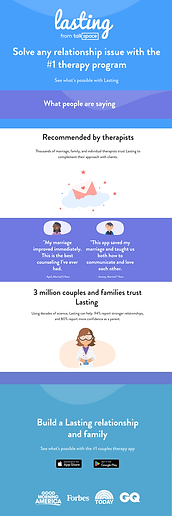
Lasting takes Gottman-adjacent research and packages it into a daily practice couples can actually maintain. The app opens daily conversations neither partner might naturally initiate: about needs, about gratitude, about what is working and what is not. Over two million couples use it, and licensed therapists consistently recommend it as a between-session tool. The key insight behind Lasting is that relationships do not fail from dramatic events. They erode from small, daily neglect. This addresses the neglect.
$59.99/year
Price:
Best For:
Couples in any stage
Why we love this . . .
It is the relationship equivalent of going to the gym together. Not dramatic, not a crisis intervention — just consistent, small investments in each other that compound over time. The conversations Lasting prompts are the ones most couples would never think to have on their own. At $59.99 a year, it is one of the best dollars-per-benefit ratios in this entire category.
91
POPCYCLE SCORE

Relish
Daily Relationship Coaching in Your Pocket
Relish sits in an interesting space between a couples app and a dating coaching tool. For people who are single and want to work on their relationship patterns and readiness before meeting someone, or for couples who want a lower-commitment daily touchpoint than Lasting, Relish offers personalized coaching, quizzes, and conversation prompts at an accessible price point. At $9.99 a month, it is the most affordable entry point in this category for people who are not yet ready for a higher-commitment program.
$9.99/month
Price:
Best For:
Singles, light couples coaching
Why we love this . . .
There is real value in something that meets you where you are — not demanding a therapist commitment or a couples deep-dive, just a small daily investment in understanding yourself and your relationship better. Relish is that entry point. For singles who want to understand their patterns before the next relationship, it is genuinely useful. For couples who want something low-key, it is a lighter alternative to Lasting. The price makes the try-it decision easy.
83
POPCYCLE SCORE

Paired
Daily questions for the two of you.
Paired is a daily practice app for couples who want to invest in their relationship without needing to book therapy. Co-founded with Dr. John Gottman, the content draws from decades of research on what actually keeps couples connected. Each day serves up a conversation prompt, quiz, or short audio exercise designed to take 10 minutes together. Great for couples who already have a good foundation and want to maintain it, or who want to build daily connection habits before small issues become big ones.
Free with Pro at $9/month or $70/year
Price:
Best For:
Established couples wanting to strengthen daily connection without starting formal therapy.
Why we love this . . .
Most couples apps either feel too clinical or too fluffy. Paired lands in the middle. The Gottman research pedigree is real, the daily prompts are good, and the time commitment is low enough that busy couples actually use it. Preventive maintenance for the relationship, not crisis intervention.
84
POPCYCLE SCORE

Gottman Card Decks
1000+ research-backed questions, free.
The Gottman Card Decks app is one of the best free resources in couples work, period. 14 themed decks cover everything from 'Open-Ended Questions' to 'Expressing Appreciation' to 'Date Night' and 'Rituals of Connection,' with over 1000 individual cards drawn directly from the Gottman research. Pull out your phone when conversation runs dry, pick a deck, answer a card. Simple, zero-pressure, surprisingly effective. The fact that it costs nothing is almost beside the point.
Free
Price:
Best For:
Any couple wanting better conversations with zero commitment or cost.
Why we love this . . .
The Gottmans have the deepest research base in couples work in the world. That they packaged it into a free app that anyone can use any night of the week is a quiet gift. Keep it on your phone. Use it on a long drive, over dinner, before bed. It works.
88
POPCYCLE SCORE

Love Nudge
The 5 Love Languages, in daily practice.
Love Nudge is the official app of Gary Chapman's 5 Love Languages framework. Each partner takes the assessment, identifies their primary love language, and the app sends daily small-action suggestions to help you speak each other's language consistently. Write a note of appreciation. Take 15 minutes to really listen tonight. Simple, specific, and designed around the single most widely-adopted relationship framework of the last 30 years. Free, with no email wall.
Free
Price:
Best For:
Couples familiar with 5 Love Languages who want help applying it daily.
Why we love this . . .
The 5 Love Languages framework is so widely known for a reason: it works for most couples, most of the time. Love Nudge takes it from theory into daily practice. For couples who read the book once and promptly stopped applying it, the daily nudge system restarts the habit.
80
POPCYCLE SCORE

Family

Good Inside with Dr. Becky
Parenting as the parent you want to be.
Dr. Becky Kennedy has become the most trusted name in parenting advice over the last 5 years, and the Good Inside platform is where her complete framework lives. Members get access to a growing library of short, specific courses: 'Tantrums,' 'Siblings,' 'Big Transitions,' plus her full podcast archive and a parenting AI trained on her methodology. Rather than teaching perfect parenting, Dr. Becky teaches parents how to repair after the inevitable moments they handled poorly. Transformative for parents who want to break generational patterns.
Membership $19/month or $190/year
Price:
Best For:
Parents of kids 1-14 who want to parent differently than they were parented.
Why we love this . . .
Dr. Becky's core insight, that we were not taught how to regulate our own emotions as children so we struggle to coach our kids through theirs, is the kind of truth that reorganizes everything. Her Good Inside platform makes her work usable at 7am before school, not just when you have time to read a parenting book.
86
POPCYCLE SCORE

OurFamilyWizard
Co-parenting infrastructure courts recognize.
OurFamilyWizard has been the most widely court-recognized co-parenting app for over a decade. For separated or divorced parents navigating shared custody, it consolidates calendars, messages, expense tracking, and documentation into one system. Messages are timestamped, cannot be edited after sending, and can be exported for family court if needed. A ToneMeter feature flags hostile language before you hit send. Pricier than some alternatives, but the court-recognition and feature depth are unmatched. Used by parents at every conflict level, from amicable to high-conflict.
$144-199/year per parent
Price:
Best For:
Divorced or separating parents, especially where documentation matters.
Why we love this . . .
Co-parenting is hard. Having one system that holds every message, every schedule, every receipt, and every calendar change in a format family courts already accept, is the kind of infrastructure that lowers conflict and keeps attention on the kids. OurFamilyWizard sets the standard for the category.
88
POPCYCLE SCORE

AppClose
Free co-parenting that actually works.
AppClose is the strongest free co-parenting app available. Shared calendars, documented messaging, expense splitting, and request/approval flows for schedule changes, all with no subscription required. The company sustains itself through optional paid upgrades and payment processing fees, not basic access. For separating parents who cannot or do not want to pay $150+/year for OurFamilyWizard, AppClose covers the essentials well. Not quite as polished or as deeply court-recognized, but functional and free, which matters.
Free
Price:
Best For:
Separated or divorced parents who want core features without a subscription.
Why we love this . . .
Separation and divorce are often expensive enough. AppClose makes the core co-parenting infrastructure available without adding another subscription. For most amicable or moderate-conflict co-parents, the free tier does the job. The 2 million+ user base is proof of concept.
80
POPCYCLE SCORE

Family Wall
A private hub for the whole family.
Family Wall gives families their own private digital space, away from the noise of regular social media. Shared calendar, photo albums, grocery lists, chat threads, and optional location sharing between family members. Especially useful for multi-generational families, families with kids who are not yet on social media, or extended families spread across cities who want to stay close without the public performance of Facebook or Instagram. Simple, private, and designed to replace the family group chat with something more useful.
Free with Premium at $40/year
Price:
Best For:
Families wanting a private, all-in-one coordination hub, including multi-generational.
Why we love this . . .
Most families coordinate through a messy mix of texts, group chats, Google calendars, and shared photo folders. Family Wall pulls those threads into one private space that older kids will actually tolerate and grandparents can figure out. Low friction, meaningful payoff.
76
POPCYCLE SCORE

Cozi
The classic family organizer.
Cozi has been the default family calendar app in the US for over 15 years, and the reason it has lasted is simple: it works. Each family member gets a color on a shared calendar, with lists (grocery, to-do, chores), meal planning, and an optional family journal rolled in. The free tier covers everything most families need; Cozi Gold adds reminders and ad removal. For families where coordination is more important than co-parenting documentation, Cozi is usually the right tool. It is especially strong for intact families, blended families, and households with teens.
Free with Gold at $30/year
Price:
Best For:
Intact and blended families coordinating schedules and lists day-to-day.
Why we love this . . .
Cozi is boring in the best way. It does not try to be a social network or a parenting coach or a photo album. It is a family calendar and lists app that has not broken, slowed down, or started charging for features it used to give away. Install it once, use it for 10 years.
82
POPCYCLE SCORE

Friendships

Meetup
In-person community, by interest.
Meetup is the longest-running platform for finding in-person groups based on shared interests. Hiking, board games, book clubs, running, language practice, professional networking, parenting support, grief groups, chess, cycling, woodworking: anything with enough people around you doing it. For adults 35 to 65 who have moved to a new city, left a job that provided social structure, or simply realized the kids are no longer the reason they see other adults, Meetup is often the first and best step back into community. Free to attend most groups.
Free to attend most groups
Price:
Best For:
Adults wanting in-person friendships built around shared interests.
Why we love this . . .
Friendship research is unanimous: the single best predictor of adult friendships is sustained repeated contact around a shared activity. Meetup is the lowest-friction way to find that contact without needing to invent it from scratch. It has worked for 20 years because it respects what actually builds connection.
85
POPCYCLE SCORE

Bumble For Friends
The friendship side of Bumble.
Bumble For Friends (formerly BFF) is Bumble's standalone app for people looking to make friends rather than date. The format mirrors Bumble's dating app, swipe-based profiles, bio prompts, mutual matches, but the context is entirely platonic. Especially popular with adults new to a city, parents whose friendships faded during the baby years, and people in life transitions (divorce, empty nest, career change) who need to rebuild their social circle intentionally. The app skews female, slightly younger than Meetup, and more urban.
Free with optional Premium
Price:
Best For:
Adults in transitions or new cities wanting a structured way to meet people.
Why we love this . . .
Making friends as an adult is hard, and most people stop trying because they do not know how to start. Bumble For Friends removes the awkwardness of 'how do I even meet someone new?' and makes it feel structured and normal. Not everyone needs this, but for the right person, it is a lifeline.
76
POPCYCLE SCORE

Peanut
Friendships for women who get it.
Peanut started as a friendship app for moms and has grown into a broader social space for women across all life stages: trying to conceive, pregnant, postpartum, parenting, menopausal, or simply looking for other women to talk to about things their male partner cannot relate to. Mix of local friend-finding, interest-based groups, and support discussions. Especially strong for women 30-55 who are tired of toxic positivity in general social media and want conversations that reflect what actually happens in women's lives.
Free with optional Premium
Price:
Best For:
Women 30-55 seeking authentic friendships and support around life stage experiences.
Why we love this . . .
Peanut treats women's experiences (pregnancy loss, perimenopause, isolation, divorce, aging parents) as the real, specific things they are. Finding other women who are going through the same thing, in your city or online, matters more than most people realize until they experience it. The platform is honest and well-run.
78
POPCYCLE SCORE
Repair

Talkspace
A Therapist in Your Pocket
Talkspace gives you access to a licensed therapist via text, audio, video, and live sessions, seven days a week. The relationship-specific therapists on Talkspace can help with patterns that show up across relationships: attachment styles, communication habits, how you handle conflict, and what you bring to partnerships from your history. Individual therapy often does more for your relationships than couples therapy alone, because it addresses what you bring to the dynamic, not just how two people interact within it.
$69-109/week
Price:
Best For:
Individual relationship patterns
Why we love this . . .
Individual therapy is underrated as a relationship tool. The work you do on your own patterns — how you attach, how you handle conflict, what you bring from your past — has a direct effect on every relationship you are in. Talkspace makes that work accessible without a waiting list or a commute. The seven-day availability is not a gimmick; sometimes the moment you need support does not fall on a Tuesday afternoon.
89
POPCYCLE SCORE

BetterHelp
Therapy That Meets You Where You Are
BetterHelp is the largest online therapy platform available, with over 30,000 licensed therapists and matching within 48 hours. For people whose relationship struggles have roots in personal history, anxiety, attachment patterns, or self-esteem, starting here before or alongside couples work is often the more effective sequence. The therapist matching considers your specific concerns, making it possible to find someone with relationship-specific expertise rather than a generalist.
$60-100/week
Price:
Best For:
Individual therapy access
Why we love this . . .
Scale matters here. 30,000 therapists means you are far more likely to find someone who specializes in exactly what you are dealing with — attachment issues, anxiety in relationships, recovering from a difficult history. The matching process is designed to surface that fit rather than just assign whoever is available. For people who have had mediocre therapy experiences, the depth of the network makes a real difference.
90
POPCYCLE SCORE

Open Path Psychotherapy
Real therapy, honestly affordable.
Open Path Psychotherapy Collective is a nonprofit network of licensed therapists (LCSWs, LMFTs, LPCs, psychologists) who agree to see members at sliding-scale rates of $30-80 per individual session, or $30-120 for couples and family sessions. One-time $65 lifetime membership fee, no recurring charges. For adults who do not have mental health coverage, have a high deductible, or simply cannot afford the $150-250 per session that private therapy now costs in most US cities, Open Path is often the single best option available. These are real licensed clinicians, not interns or chatbots, offering real sessions at rates that make ongoing weekly therapy actually sustainable.
$30-80/session, one-time $65 lifetime fee
Price:
Best For:
Adults with household income under $100k who need affordable licensed therapy.
Why we love this . . .
Therapy works. The problem for most people is cost. Open Path solves the cost problem without compromising on who you are seeing: these are credentialed therapists choosing to offer reduced-rate slots because they believe access matters. The $65 lifetime fee is not a trick, there are genuinely no recurring charges. For many of our readers, this is the difference between therapy happening or not.
90
POPCYCLE SCORE
🎯
The full
comparison
Side by Side
Compare our favorite choices and best picks side by side.
The Rundown
Product
Pricing
Best for:
Pop Score
See Full Review
Good Inside with Dr. Becky
Dr. Becky Kennedy's membership platform combining short video courses, podcast library, and AI parenting assistant for in-the-moment challenges.
Price:
Membership $19/month or $190/year
Best for:
Parents of kids 1-14 who want to parent differently than they were parented.
86
POPCYCLE SCORE
Open Path Psychotherapy
Nonprofit therapist network offering licensed therapy at $30-80 per session after a one-time $65 lifetime membership. No insurance required.
Price:
$30-80/session, one-time $65 lifetime fee
Best for:
Adults with household income under $100k who need affordable licensed therapy.
90
POPCYCLE SCORE

Frequently Asked Questions
🎯
uestions we
actually
answer. . . a lot.
Q
Here are some of the most frequently asked questions about creating amazing relationships
Q.
Is dating different after 40 or 50?
Q.
How do I spot a scam or fake profile on a dating app?
Q.
Does BetterHelp actually work as well as in-person therapy?
Q.
Is it worth paying for a dating app?
Q.
What is the best dating app for serious relationships?
Q.
Do we need couples therapy, or will an app help?
Q.
What are the 5 Love Languages?
Q.
How do we fight better as a couple?
Q.
How do we rebuild connection after years together?
Q.
What is the Gottman Method?
Q.
How do I set boundaries with difficult family members?
Q.
What is the best way to co-parent after divorce?
Q.
How do I reconnect with an adult child?
Q.
How do I help my kids through my divorce?
Q.
Why is it so hard to make friends as an adult?
Q.
What are the best apps for making friends?
Q.
How do I maintain long-distance friendships?
Q.
Does therapy actually work?
Q.
How much does therapy cost in 2026?
Q.
What is the difference between a therapist, counselor, and coach?
Q.
When should I consider couples therapy vs individual?
Q.
What is the PopScore based on?
Q.
Do you earn commissions from these recommendations?
Q.
How often are Popcycle recommendations updated?
Q.
How do I know which recommendation is right for me?
Q.
Who runs Popcycle?
Ready to start somewhere?
Every product on this site comes with a free trial or a reasonable entry point. The best move is the one you actually make. Pick the category that feels most urgent, try one thing, and give it a fair shot.
Click below to visit any of the Popcycle category hubs for our Start Here resources, Podcast picks, Book recommendations, free tools, and products that you might never otherwise find to Sweeten your life.
 |  |  |  |
|---|---|---|---|
 |  |
popcycle
sweeten your life


A note on how we keep the lights on.